
Alternative treatments of Epilepsy
Surgical treatment of Epilepsy
Surgery may be considered in the treatment of partial epileptic syndromes, in order suppress or potentially terminate the recurrence of seizures. Surgery may also be considered in generalised epilepsy but due to the focal nature of the treatment this is less common. Five main approaches are currently in practice:
- Focal resection for lesions of the mesial temporal lobe (account for 60% of epilepsy related surgeries)
- Focal resections for overt lesions in the other cortical areas (a.k.a. lesionectomies; account for 20% of epilepsy related surgeries)
- Non-lesional focal resections (i.e. the removal of tissue on functional grounds rather due to the presence of anatomical abnormalities)
- Resection of cerebral lobes (Hemispherectomies, hemispherotomies etc.)
- Functional procedures (e.g. vagal nerve stimulation (VNS), subpial transection, corpus callosectomies, and focal ablation and stimulations)
In the past anterior callostomies were the most commonly performed surgery, used in the treatment of medically intractable atonic seizures, particularly significant as effected individuals are particularly prone to injury during seizures due to falling. This practice has since been surpassed by VNS (implantation of a small generator onto the vagus nerve) in these patients.
Surgical planning requires the assessment of numerous factors. Firstly surgery will only be considered where seizures prove to be sufficiently medically intractable (for which the criteria varies, though all account for the possible late onset of anticonvulsant effects). Detailed investigation into the epileptogenic area must be undertaken, normally using EEG video monitoring with intracranial electrodes. The aetiology is also a key factor, thus detailed imaging of the epileptogenic area must be undertaken. The patients medical history, age, health and psychiatric condition must also be weighed to accurately determine the chances of successful surgery and the quality of life likely to be experienced post surgery.
|
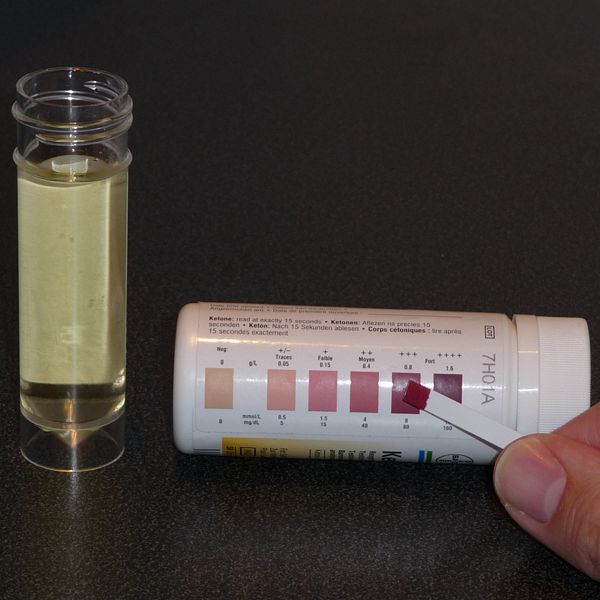
From https://en.wikipedia.org/wiki/Image :Ketonuria.jpg under the wikimedia commons liscence |
The control of epilepsy is not always the primary cause for surgical intervention, but is however an important factor that must be considered in surgical planning.
Dietary changes in the treatment of Epilepsy
Aside from removing precipitants of epilepsy such as alcohol, dietary changes can prove effective in controlling seizures. The high fat, moderate protein, low carbohydrate ketogenic diet is proved to improve the condition of many patients epilepsy, and in some instances of difficult to treat child epilepsy, may be compose a significant part of treatment. By forcing the body to burn an increased level of fat, an increase in the production of ketone bodies at the liver is seen, which yields anticonvulsant effects. The diet is however difficult to maintain, only 1 in 20 sticking to it within a year. Preliminary data suggests a similar effect may be seen with an perhaps slightly modified “Atkins” diet.